Castles of Mad King Ludwig
- 4.4
- Rating
- 10.00K
- Installs
- $7.99
- Price

 Analysis by App-foxy
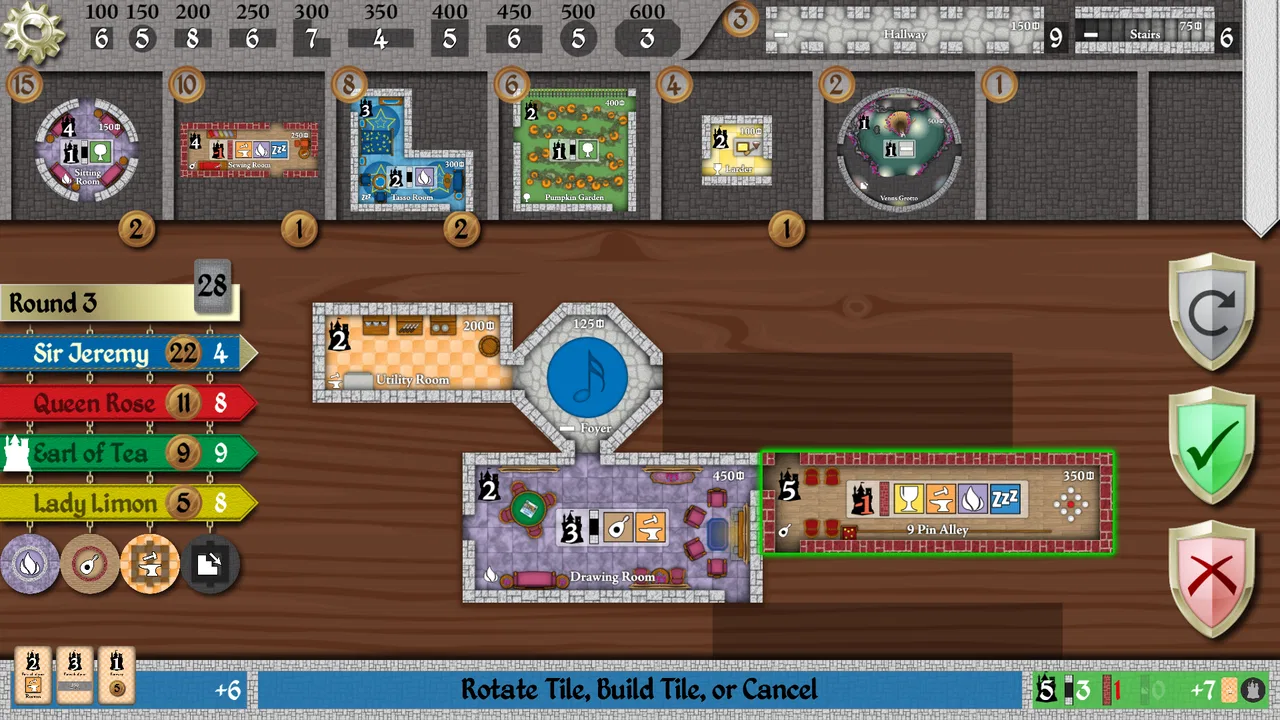
I enjoy board games that make every decision feel personal, and Castles of Mad King Ludwig has that quality in a compact digital form. Instead of moving armies across a map or simply collecting points from cards, I spend each turn shaping a strange royal castle room by room. The result is a board game adaptation with a strong architectural theme, thoughtful planning, and enough interaction to keep the table from feeling like a collection of separate puzzles.
This is a paid board game for Android, developed by Bezier Games. It costs $7.99, so the purchase decision matters more here than it would with a free casual title. I would not describe it as a quick distraction for every phone owner. I see it as a digital version aimed at people who already enjoy strategic tabletop games, or players willing to learn a fairly unusual scoring system in exchange for a more deliberate experience.
Building a castle one decision at a time
The central idea is easy to understand: I build my own castle by adding rooms, but the rooms are not interchangeable decorations. Their positions, connections, functions, and relationships affect how well the castle develops. A room that looks useful on its own may be less attractive if it blocks a better plan, while a seemingly modest addition can become valuable when it completes a chain of connected spaces.
You May Also Like

 Blood Strike: 2.5 Anniversary
Blood Strike’s Loadouts Turn Every Drop Into a Tactical Gamble
A close look at Blood Strike’s custom loadouts: how fast access to signature weapons reshapes its battle royale rhythm, rewards preparation, and narrows the gap between fights.

 Pandora - Music & Podcasts
Pandora’s Music Is Easy to Start, but Harder to Recover
Pandora’s strength is its low-effort path from a seed to a station. Its weak spot is how much confidence it asks you to place in connection, setup, and quiet recovery.

 8 Ball Pool
 Is Built on Rivalries, Rematches, and Routine
A close look at the rivalries, rematches, shared routines, and unanswered safety questions that turn a quick pool match into a persistent mobile community.

 Samsung Music
’s Quiet Strength Is Playing What You Already Own
Its reach comes less from spectacle than from dependable access to a personal library. That simplicity is both the app’s strongest retention engine and its ceiling.

 AccuWeather: Weather Radar
AccuWeather Review: A Quick, Clear Forecast for Everyday Decisions
For everyday plans, the best forecast is the one you can understand quickly. AccuWeather makes rain timing, radar, and local conditions easy to act on, with a few trade-offs.

 Hill Climb Racing
Why Hill Climb Racing Still Turns Crashes Into One More Run
A tiny car, a bumpy hill and one more upgrade: Hill Climb Racing keeps resurfacing because its simple chaos makes every near-miss feel personal.
More From Our News Desk
View All News


That tension gives the game its character. I am not merely asking which room produces the biggest immediate reward. I am considering whether it fits the shape of my castle, whether another player is likely to take it, and whether its special scoring condition is worth pursuing. The theme helps make those choices memorable, because I can look at the growing layout and understand why one decision changed the direction of the whole building.
The digital adaptation keeps the focus on the board game rather than burying it beneath unrelated systems. That is important for me. Some mobile strategy games add energy timers, constant unlock tracks, or layers of currency that distract from the main design. This one is much easier to approach as a self-contained board game purchase: open it, learn the rules, and concentrate on constructing a better castle.
The age rating is Everyone, which makes the presentation broadly approachable. That does not mean the strategy is childish. The rules are suitable for a wide audience, but the scoring can still make experienced players pause before committing to a room. I would happily introduce it to a family member who likes puzzles, although I would explain the scoring before expecting a first-time player to make strong choices.
Why the room market creates real tension
One of the most interesting parts of the design is that room value is not fixed in the way a simple matching game’s value might be. The way rooms are offered and priced gives the decisions a social edge. I have to think not only about what I want, but also about what another player may be prepared to pay or take. That makes the castle-building process feel more interactive than a private tile-laying exercise.
A useful habit is to look at the available rooms before deciding what my castle supposedly needs. I often enter a turn with a plan for a particular type of space, then change direction because the available choice creates a better connection or blocks an opponent’s likely route. That flexibility is more valuable than stubbornly following an opening strategy.
Another subtle point is that an attractive room can be a trap. A large or rewarding space may consume valuable room in the layout, create awkward connections, or pull attention away from a scoring condition that is easier to complete. I get better results when I judge a room by its effect on the whole castle rather than by its isolated reward.
Learning the scoring without losing patience
The first game can feel less intuitive than the castle theme suggests. New players usually understand the act of placing rooms quickly, but the reasons behind the best placement may take longer. Different goals encourage different layouts, and the most visually pleasing castle is not automatically the most successful one.
I recommend treating the opening session as a learning game rather than trying to win immediately. Pay attention to which rooms become difficult to connect, which spaces remain unused, and which scoring opportunities were visible early but ignored. After one complete game, the choices become easier to read because the symbols and relationships have practical meaning rather than appearing as abstract instructions.
The game rewards players who pause before confirming a placement. That may sound obvious, but the temptation to grab a room quickly is strong when it appears to fit. I now check three things: how the room connects, what it prevents me from adding later, and whether it supports a scoring goal I can realistically finish. This simple checklist has improved my decisions more than memorizing a fixed opening.
How the digital version fits everyday play
I find the game most useful when I want something more substantial than a five-minute mobile diversion but do not want to organize a physical game night. A quiet evening at home is a good example. I can play a thoughtful session while having a drink, stop between turns, and return to the castle without needing a table covered in components.
It also works well for people who like board games but do not enjoy managing setup. A physical castle-building game asks players to sort pieces, explain scoring, keep the market organized, and check that everyone has followed the rules. The app handles that administrative work, leaving me to concentrate on the decisions. For a solo player, that convenience is especially valuable because I do not need to recruit opponents before I can play.
At the same time, the app cannot completely replace the social atmosphere of a physical table. A board game night includes conversation, visible reactions, and the pleasure of watching another person rethink a plan. The digital format gives me cleaner turns and less clutter, but it may feel quiet if what I really want is a shared social event.
The game is also better suited to players who enjoy turn-based thinking than to people seeking constant action. I can take time to compare options, and that is part of the appeal. If you prefer a fast puzzle with immediate feedback, the deliberate pace may feel slow. If you like weighing several imperfect choices, the pauses are where much of the enjoyment lives.
A practical approach for first-time players
For a first session, I would avoid trying to force a perfect castle theme. Build a functional foundation first and learn how the room types interact. It is tempting to chase every visible bonus, but spreading attention across too many goals can leave the castle with several unfinished ideas instead of one coherent plan.
I also suggest watching the other players’ layouts, not just their scores. A rival who is collecting a particular kind of room may be signalling which options they value, while an opponent with a cramped layout may be less dangerous than their early points suggest. The visible castle gives useful information, and ignoring it turns an interactive game into a weaker version of solitaire.
When playing against someone new, I would explain the purpose of connections and scoring goals before discussing advanced tactics. Giving every rule at once can make the first game feel like homework. A better introduction is to describe the basic placement logic, then point out why a room may be valuable in one castle but awkward in another.
What the purchase gives you, and what it does not
The price is straightforward: this is a $7.99 purchase rather than a free entry point. That makes the value easy to judge in one sense, because I am paying for access to the game itself instead of deciding whether optional spending is necessary to keep progressing. I appreciate that clarity, but it also means the game has to earn its place on my device through replay value and quality of adaptation.
For me, the value comes from the kind of decisions the design supports. A single castle can develop in several directions, and the room market changes the priorities from game to game. I do not feel that I am repeating the exact same puzzle every time, even though the basic rules remain familiar. That variability is more important than a long list of side features.
The purchase is less convincing for someone who only wants occasional casual play. If you open a board game app once every few months, a paid title may not offer enough value compared with free puzzle games or a physical game already sitting on your shelf. I would buy this because I expect to return to its strategic system, not because the price is negligible.
The app’s current version is 2.1.4, and it supports devices running Android 4.1 or later. Those details make it accessible to a broad range of older Android hardware, although compatibility on paper is not the same as a perfect experience on every device. On a small screen, room layouts and scoring information can require closer attention than they would on a physical table or a larger tablet.
Where it compares well with other board games
Compared with a traditional abstract tile-laying game, this adaptation gives my placements more personality. I am not only matching edges or building a high-scoring pattern; I am trying to make the whole castle satisfy several competing demands. That extra layer makes each room feel like part of a plan rather than merely the next piece in a sequence.
Compared with a light card game, it asks for more spatial awareness and long-term planning. Card games often let me hold options in reserve, while this castle develops visibly in front of me. Mistakes are harder to hide, but that also makes improvement easier because I can see exactly where my layout became inefficient.
Compared with a complex strategy game, it is more approachable once the scoring language becomes familiar. There is still depth, but the theme gives the decisions a physical shape. I do not need to manage a huge technology tree or remember dozens of independent systems. The challenge comes from combining rooms, timing purchases, and reading the developing castle.
That middle position is its strongest niche. It is more thoughtful than a casual matching game, yet less demanding than a long simulation. Players who want a gentle introduction to modern board-game design may find it a good bridge. Players who already prefer very heavy strategy may eventually want something with more systems and a longer arc.
The limitations I noticed during play
The biggest friction is the learning curve around scoring. The basic action is clean, but the consequences of a placement are not always obvious to a new player. A first-time user may understand what can be built without understanding what should be built. That gap can make an early loss feel confusing rather than educational.
The screen presentation can also affect comfort. A castle layout contains several details that are easy to read at a table, while a phone compresses them into a smaller space. I prefer playing on a larger screen when possible, especially when comparing multiple rooms or reviewing why a score changed. The game remains workable on mobile, but this is not the kind of board game I would choose for a rushed glance while standing in line.
There is also a difference between strategic depth and endless variety. The core decisions are strong, but anyone expecting a constantly expanding stream of content may be disappointed by the focused design. I see that focus as a virtue when I want a board game rather than a service, yet it may feel limited to players who measure value mainly by the number of modes or unlockables.
Finally, the game is not ideal for people who dislike indirect competition. Another player can affect my plans simply by taking a room I was waiting for or changing the value of the market. That interaction is central to the experience, but it can frustrate anyone who wants complete control over a private puzzle.
Who will get the most from it
I would recommend it to someone who enjoys planning several turns ahead but still wants choices to remain flexible. It suits players who like seeing a visual project grow, because the castle is both the playing area and a record of earlier decisions. It is also a strong fit for fans of tabletop adaptations who value rules enforcement and quick setup more than the physical presence of cards and tiles.
Families can enjoy it if at least one person is willing to teach the scoring patiently. The Everyone rating makes the presentation accessible, but younger or inexperienced players may need help understanding why a room that looks impressive is not always the best move. I would keep the first game relaxed and focus on discovering the relationships between rooms.
Solo-minded players should consider whether the app’s appeal comes from competing with others or from solving the building challenge itself. If the pleasure is in optimizing a castle, the digital format is convenient. If the pleasure is mostly in table talk and reading opponents face to face, the physical board game will probably offer a warmer experience.
I would skip it if I want instant action, a free trial before spending money, or a game that can be understood completely in a few seconds. I would also skip it if spatial layouts make me uncomfortable or if I dislike games where a good plan can be disrupted by another player’s purchase. Those are not minor details; they define how the game feels from turn to turn.
My buying verdict
My verdict is positive, with a clear condition: buy it if you want a focused, paid board game that rewards repeated thought rather than constant novelty. The $7.99 price is reasonable for the experience I get from a polished castle-building adaptation, but only if I am genuinely interested in learning its scoring and returning to improve.
The game’s 4.4 average from around 1.1 thousand ratings and more than 10 thousand installs suggest that it has found a committed audience, while the 209 written reviews indicate that players have had plenty to say about it. I would treat those figures as useful context, not as a substitute for knowing my own preferences. A well-liked strategy game can still be the wrong purchase for someone seeking a relaxed, instantly readable app.
Bezier Games has chosen a design that benefits from digital convenience without losing the appeal of a physical construction puzzle. I like that every room can force a change of plan, and I like even more that the finished castle shows the consequences of my choices. The adaptation asks for patience at first, but it gives that patience something worthwhile in return.
If you enjoy turning limited options into a carefully connected castle, this is a purchase I can recommend. If you want a free, fast, or highly social mobile game, I would look elsewhere. For the right player, however, it delivers a distinctive board-game experience: part spatial puzzle, part negotiation over valuable rooms, and part long-term exercise in knowing when a beautiful idea is actually a bad investment.
FAQs for Castles of Mad King Ludwig
01What is Castles of Mad King Ludwig?
Castles of Mad King Ludwig is a digital adaptation of the popular castle-building board game. You take the role of a builder designing extravagant castles by purchasing and placing rooms, connecting corridors, and satisfying architectural requirements. The game combines tile placement, resource management, and strategic bidding, while the unusual room shapes and royal demands make every castle develop differently from the previous one.
02How does the gameplay work?
Each round, players compete for rooms arranged by a master builder and pay using the game’s currency. The room prices are determined before the bidding begins, so choosing fair values is an important part of the strategy. After acquiring a room, you attach it to your castle and try to create useful connections, complete bonuses, and meet scoring objectives without wasting space or money.
03Is Castles of Mad King Ludwig suitable for beginners?
The game is approachable once the basic room-placement and scoring rules are understood, but it is more strategic than a simple casual building game. New players may need a few rounds to learn how room connections, bonuses, public goals, and bidding interact. The digital format is helpful because it handles scoring and rule calculations automatically, reducing the amount of manual bookkeeping.
04Can I play Castles of Mad King Ludwig offline or with other players?
The available play options can depend on the version and platform, so it is worth checking the current store listing before downloading. The adaptation is designed around competitive castle construction and may include solo play against computer-controlled opponents as well as multiplayer modes. An internet connection may still be required for online features, account services, updates, or certain matchmaking functions.
05Does the game include in-app purchases or require an account?
Before installing, review the Google Play or App Store listing for the latest information about pricing, advertisements, in-app purchases, and account requirements. Digital board-game editions are often sold as premium apps or may offer optional expansions and additional content. The core experience should be evaluated separately from any add-ons, especially if you want a complete strategy game without recurring purchases.
Pros
- Creative castle-building system with satisfying room-placement decisions.
- Strong solo mode with challenging AI opponents.
- Beautiful artwork and whimsical medieval theme.
- Scoring objectives encourage varied strategies each game.
- Easy to learn
- yet offers plenty of strategic depth.
Cons
- Some games can feel lengthy
- especially with several players.
- Random room availability may occasionally limit strategic options.
- Scoring rules take time to understand for first-time players.
- The interface can feel cramped on smaller phone screens.
- Replay value may decrease if you prefer fast
- highly varied games.

Castles of Mad King Ludwig
Gallery